Shanghai
A first-timer's Shanghai, with Pudong, Hongqiao and the maglev, the metro, sights to book, where to stay, what to eat, water towns and how long to stay.
Shanghai is China’s biggest and most international city, split by the Huangpu River into Puxi, with the Bund and the old lanes, and Pudong, with the skyscrapers of Lujiazui. It is the easiest Chinese city for a first-timer, with a lower booking wall than Beijing, but it still runs on phone payments, scan-to-order menus and a metro you need to read.
Arriving in Shanghai: Pudong, Hongqiao and the maglev
Shanghai has two airports, and most international flights use Pudong.
- Shanghai Pudong International Airport (PVG) is east of the city, near the coast. The maglev runs from Pudong Airport to Longyang Road station in Pudong, where you change to the metro. It is fast but does not reach central Puxi, so for many hotels you’ll still need a metro ride or taxi after it. Metro Line 2 also runs from the airport into the city, more slowly.
- Shanghai Hongqiao International Airport (SHA) is west of the center and mainly handles domestic and regional flights. It sits right next to Hongqiao Railway Station, and Metro Lines 2 and 10 serve it.
Allow plenty of time if you have to transfer between Pudong and Hongqiao; they are on opposite sides of the city.
Arriving by train, most high-speed trains from Beijing and the Yangtze Delta use Shanghai Hongqiao Railway Station, though some use Shanghai Railway Station and other stations. Check your ticket, and book on 12306, the official rail channel. For entry rules see Visas and entry, and for your first day see First 24 hours.
Getting around Shanghai
The Shanghai metro is one of the largest in the world and the best way to get around. Signs and announcements are in English and Chinese.
- Line 2 runs east to west across the river, linking Hongqiao, Jing’an Temple, People’s Square, East Nanjing Road and Lujiazui, and on to Pudong Airport.
- Line 10 links Hongqiao with Xintiandi, the Yu Garden area and East Nanjing Road.
- Line 1 runs north to south through People’s Square and the former French Concession.
Ferries across the Huangpu are cheap and give you a river view of both skylines. Taxis and ride-hailing are plentiful, and shared bikes suit the flat, tree-lined streets of the former French Concession. Pay with Alipay or WeChat Pay; see Paying in China and Getting around.
Shanghai’s must-see sights and which ones need booking
Shanghai’s top sights, and how to get in:
- The Bund: the riverfront of colonial-era banks and trading houses, free and open, best at dusk.
- Lujiazui: the Pudong skyline across the river; the tallest towers have paid observation decks.
- Yu Garden and the Old City: a classical garden with ticketed entry, surrounded by busy bazaar lanes and the City God Temple.
- The former French Concession: plane trees, villas and lane houses, best on foot.
- Shanghai Museum: Chinese art and antiquities, with its original building at People’s Square and a newer East branch in Pudong. Reservation by passport through the official channel.
- Jade Buddha Temple: an active Buddhist temple in Puxi.
- Shanghai Disney Resort: buy tickets through official channels well ahead for weekends and holidays.
Fewer Shanghai sights demand a week’s notice than in Beijing or Xi’an, but museums and special exhibitions still need a booking, and many museums close on Mondays.
Check before you go: Reservation rules, release windows and closing days change. Check each sight’s official channel, and see our sight bookings tool and the Booking sights guide.
Where to stay in Shanghai, by metro line
The best base in Shanghai is near Line 2 or Line 10, which tie together the airports, the Bund and the main districts. The big choice is Puxi or Pudong.
- People’s Square and East Nanjing Road (Lines 1, 2, 8, 10): central, walkable to the Bund, and well connected.
- Jing’an (Lines 2, 7, 14): upscale, with good dining and easy access to both the old and new city.
- Former French Concession and Xintiandi (Lines 1, 10, 13): leafy and atmospheric, with cafés and bars.
- Lujiazui in Pudong (Lines 2, 14): skyline views and big hotels, closer to Pudong Airport but quieter at night.
If you’re flying from Hongqiao or catching a high-speed train, a final night near Line 2 or Line 10 is convenient. Your hotel registers you with the police at check-in; see Hotels and registration.
What to eat in Shanghai
Shanghai food is sweet, rich and delicate, and the city also has some of the best food from every other region of China.
- Soup dumplings (小笼包 xiǎolóngbāo): thin-skinned dumplings filled with pork and hot broth. Bite a small hole, sip the soup, then eat.
- Pan-fried buns (生煎 shēngjiān): crisp-bottomed buns, also filled with soup.
- Red-braised pork (红烧肉 hóngshāo ròu): the classic of Shanghai home cooking, called benbang cuisine.
- Scallion oil noodles (葱油拌面 cōngyóu bànmiàn): simple, cheap and excellent.
- Hairy crab (大闸蟹 dàzháxiè): a seasonal treat in autumn.
- Breakfast: fried dough sticks, soy milk, sticky rice rolls and flatbreads from street stalls.
Popular restaurants often have queues managed by phone. Food and ordering covers scan-to-order menus and the phrases you need.
Day trips from Shanghai: water towns and the Yangtze Delta
Shanghai is a great base for day trips by high-speed rail and by metro.
- Suzhou: famous classical gardens and canals, a short high-speed train ride away.
- Hangzhou: West Lake, tea hills and temples, reachable in about an hour on the fastest trains.
- Nanjing: a former capital with city walls, museums and memorials, a longer day.
- Water towns: canal villages with stone bridges. Zhujiajiao is the easiest to reach from the city; Wuzhen, Xitang, Zhouzhuang, Tongli and Nanxun are farther out. Go on a weekday and early to avoid the crowds.
Book trains on 12306 and expect weekend and holiday trains to sell out.
How many days in Shanghai?
Three or four days in Shanghai is a good first visit, plus a day or two for trips out.
- Day 1: The Bund, East Nanjing Road and a ferry to Lujiazui for the skyline at night.
- Day 2: Yu Garden and the Old City in the morning, the former French Concession in the afternoon.
- Day 3: Shanghai Museum, Jing’an Temple and an evening walk along Suzhou Creek or the riverside.
- Day 4: A water town, Suzhou or Hangzhou.
Summer is hot and humid, with a rainy season in early summer and typhoons possible later; spring and autumn are the most pleasant. Shanghai pairs well with Beijing by high-speed train, and many visitors fly on to Xi’an or Chengdu.
The book: Shanghai, Day Zero
Shanghai, Day Zero: A First-Timer’s Guide to the Walls You’ll Actually Hit, by Kevin Gu, goes much deeper than this page. It is built around the walls visitors actually hit: two airports and a maglev to choose between, a city that runs on phone payments, apps you can’t reach from home, the handful of sights that must be booked ahead, a river that splits the city in two, and menus you scan rather than read.
Each chapter explains what stands in the way and how to get past it, then tells the story behind the Bund, the Old City and the lane houses, along with riverside walks and museums most guides miss. It covers Pudong or Hongqiao, which Shanghai sights actually need a reservation, choosing a bed in Puxi or Pudong, how to eat a soup dumpling, Shanghai’s weather, Disney and Legoland, high-speed rail day trips to the Yangtze Delta, water towns without the crowds, and sample routes for 3, 4 and 6 days, with a phrasebook and place names in characters and pinyin. The facts are checked for travel in 2026 and 2027, and the US edition is written for readers from the United States and Canada.
The book is coming soon to ebook stores. See the contents and details at Shanghai, Day Zero.
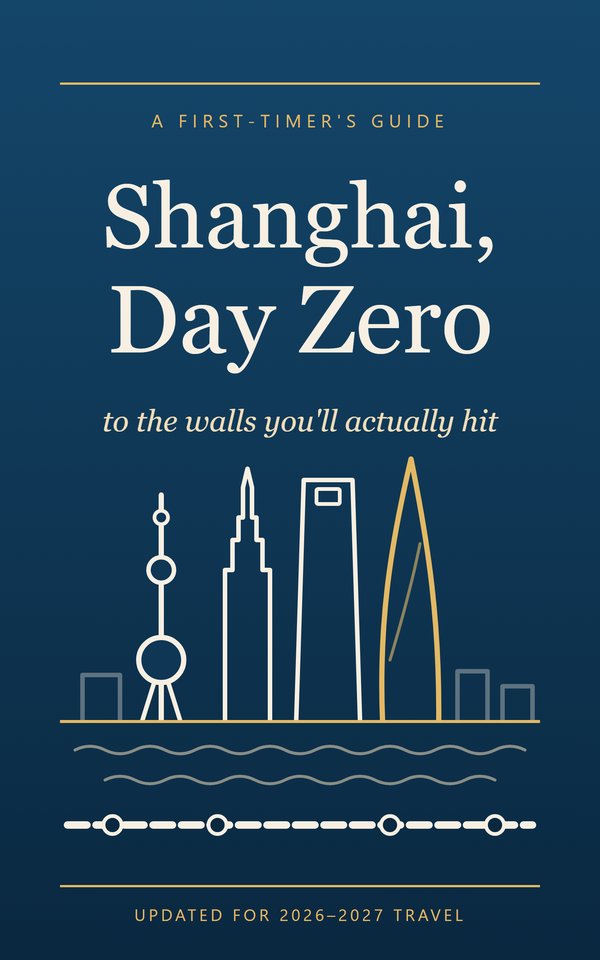
Shanghai, Day Zero
A First-Timer's Guide to the Walls You'll Actually Hit. A first-timer's guide to Shanghai, built around the walls visitors actually hit: two airports and a maglev to choose between, a city that runs on phone payments, apps you can't reach from home, the handful of sights that must be booked ahead, a river that splits the city in two, and menus you scan rather than read.
See the bookStill unsure? Ask the assistant: it answers from these guides and links the sources.
Ask AI